Whole Numbers for Math Olympiad: Why This Topic Matters
Whole Numbers for Math Olympiad may look easy at first. After all, students learn counting numbers, zero, addition, subtraction, multiplication, and division at an early stage.
But Olympiad questions rarely stop at basic calculations.
Instead, they use familiar whole-number concepts to test logical thinking, number properties, pattern recognition, mental calculation, and problem-solving speed. A question may appear simple but require you to notice a hidden pattern or use a mathematical property in an unexpected way.
For Class 6 Olympiad students, the goal is therefore not just to remember definitions. You need to understand why a property works, when to use it, and how to recognize the shortcut hidden inside a problem.
This guide will help you build that foundation and prepare effectively for Whole Numbers for Math Olympiad.
What Are Whole Numbers?
Whole numbers are the numbers that begin with 0 and continue indefinitely:
0, 1, 2, 3, 4, 5, 6, …
One of the first things students should remember is:
0 is a whole number.
Natural-number conventions can vary between textbooks, but whole numbers always include zero in the standard Class 6 definition.
Olympiad questions can use this simple fact to create tricky problems involving successors, predecessors, operations, and number properties.
Important Whole Number Concepts for Olympiad Preparation
Before attempting difficult Olympiad questions, make sure you are comfortable with these concepts.
1. Successor and Predecessor
The successor of a whole number is the number that comes immediately after it.
Successor of 25 = 26
The predecessor is the number that comes immediately before it.
Predecessor of 25 = 24
For a whole-number problem, pay special attention to zero. The predecessor of 0 is not a whole number.
Olympiad Tip
When a question gives you the successor or predecessor of an unknown number, work backward carefully rather than guessing.
2. Closure Property
Whole numbers are closed under:
- Addition
- Multiplication
For example:
8 + 12 = 20
and
8 × 12 = 96
Both results are whole numbers.
However, whole numbers are not closed under subtraction and division.
For example:
5 − 8 = −3
Since −3 is not a whole number, whole numbers are not closed under subtraction.
Similarly:
5 ÷ 2 = 2.5
and 2.5 is not a whole number.
Understanding closure is useful because Olympiad questions may ask students to identify which operation always produces a whole number.
3. Commutative Property
The commutative property means that changing the order of numbers does not change the answer.
For addition:
a + b = b + a
For multiplication:
a × b = b × a
For example:
27 + 13 = 13 + 27
and
8 × 15 = 15 × 8
Important Trap
Subtraction and division are not commutative.
10 − 4 ≠ 4 − 10
and
12 ÷ 3 ≠ 3 ÷ 12
Olympiad questions often test whether students know exactly where a property applies.
4. Associative Property
The associative property allows numbers to be grouped differently without changing the result.
For addition:
(a + b) + c = a + (b + c)
For multiplication:
(a × b) × c = a × (b × c)
For example:
(20 + 30) + 50 = 20 + (30 + 50)
Both equal 100.
Similarly:
(2 × 5) × 10 = 2 × (5 × 10)
Both equal 100.
Olympiad Shortcut
When calculating mentally, group numbers that are easy to combine.
For example:
25 + 38 + 75
Instead of adding from left to right:
25 + 75 = 100
Then:
100 + 38 = 138
Recognizing useful groupings can save time.
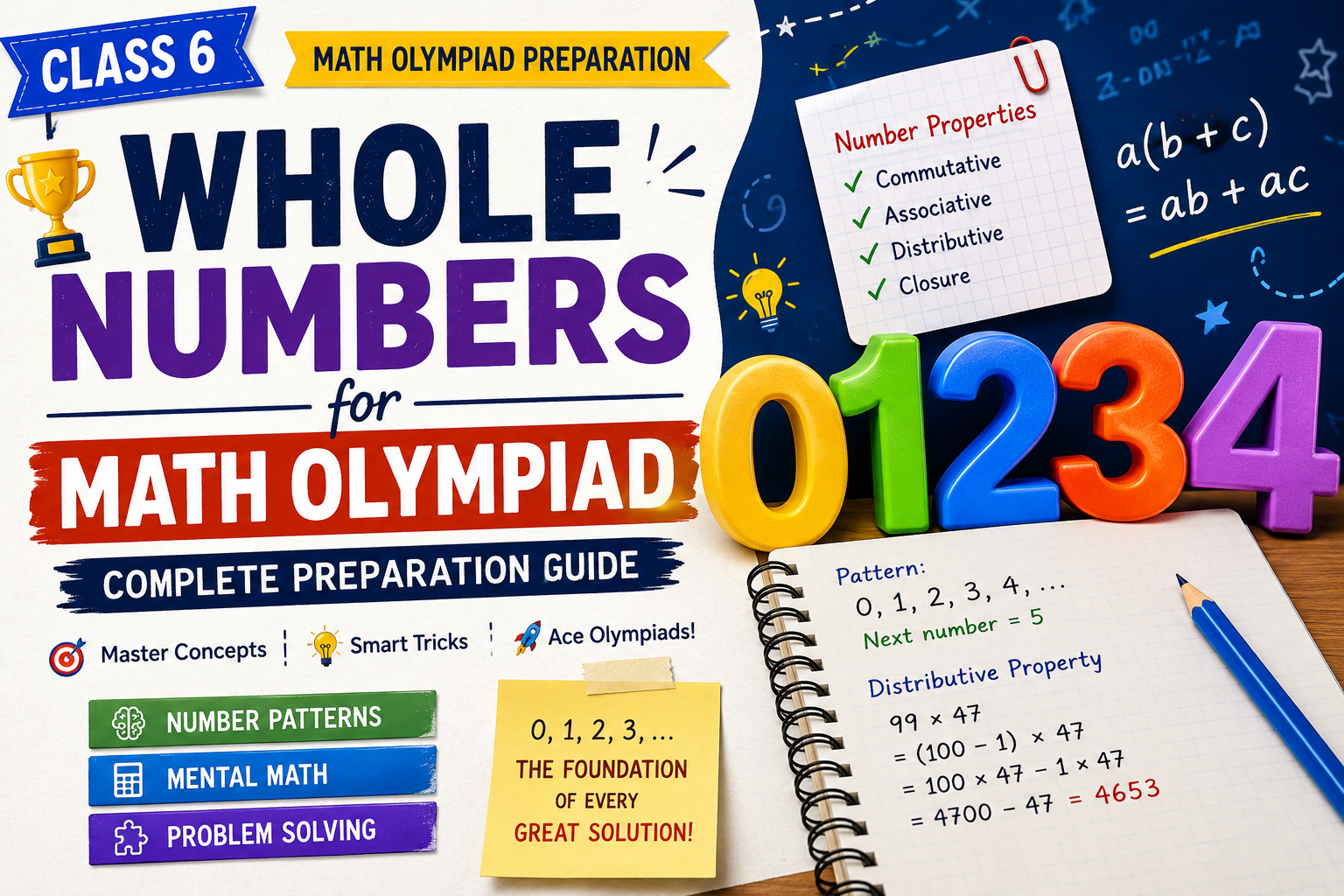
5. Distributive Property
The distributive property is one of the most useful tools for Olympiad calculations.
For multiplication over addition:
a × (b + c) = a × b + a × c
For multiplication over subtraction:
a × (b − c) = a × b − a × c
For example:
99 × 47
Rewrite 99 as:
100 − 1
Therefore:
99 × 47 = (100 − 1) × 47
= 100 × 47 − 1 × 47
= 4700 − 47
= 4653
This type of transformation can turn a difficult multiplication problem into a quick mental calculation.
Best Strategy for Preparing Whole Numbers for Math Olympiad
Simply solving textbook exercises is not enough for Olympiad preparation.
Use a structured approach.
Step 1: Master the School-Level Basics
Start with your Class 6 mathematics textbook.
Make sure you understand:
- Whole numbers
- Number line
- Successor and predecessor
- Properties of whole numbers
- Addition and subtraction
- Multiplication and division
- Patterns
- Estimation and mental calculation
Do not rush through the basic concepts.
Olympiad questions often become difficult because they combine simple concepts in unusual ways.
Step 2: Learn the Properties, Not Just the Names
Don’t memorize:
“Commutative property means changing the order.”
Instead, understand where it works.
Ask yourself:
- Does it work for addition?
- Does it work for multiplication?
- Does it work for subtraction?
- Does it work for division?
This approach makes it much easier to solve unfamiliar Olympiad questions.
Step 3: Practice Number Patterns
Number patterns are a common way to test reasoning.
For example:
2, 4, 8, 16, 32, ?
Each number is multiplied by 2.
So the next number is:
64
But Olympiad questions can make patterns less obvious.
You may need to check:
- Differences
- Multiplication
- Division
- Alternating operations
- Square numbers
- Cubes
- Increasing differences
- Repeating patterns
Important Tip
Never assume a pattern after looking at only two numbers.
Check several terms before deciding what rule is being used.
Step 4: Improve Mental Math
Speed matters in competitive examinations.
The distributive property can make mental calculations much easier.
For example:
48 × 25
Since:
25 = 100 ÷ 4
we can calculate:
48 × 25 = 48 × 100 ÷ 4
= 4800 ÷ 4
= 1200
Look for numbers that can be transformed into convenient values.
Common useful numbers include:
- 25
- 50
- 75
- 99
- 100
- 125
- 200
- 500
- 1000
The more you practice, the faster you become at recognizing these shortcuts.
Step 5: Solve Olympiad-Level Questions
After mastering the concepts, move beyond routine textbook questions.
Try problems that require:
- Multiple steps
- Pattern recognition
- Logical deduction
- Number properties
- Mental calculation
- Careful reading
The purpose is not simply to get more questions right.
You should learn why a particular method works.
Step 6: Practice Under Time Pressure
Once you are comfortable with the concepts, introduce timed practice.
For example:
10 questions → 15 minutes
After completing the set, don’t only check your score.
Analyze:
- Which questions took too long?
- Which mistakes were calculation errors?
- Which concepts were unclear?
- Did you miss a shortcut?
- Did you misread the question?
This analysis is an important part of Olympiad preparation.
Common Mistakes in Whole Numbers for Math Olympiad
Even strong students can lose marks through small mistakes.
Mistake 1: Forgetting That Zero Is a Whole Number
Remember:
0 ∈ Whole Numbers
This is one of the most basic but frequently tested facts.
Mistake 2: Using a Property Where It Does Not Apply
Commutativity works for addition and multiplication.
It does not work for subtraction and division.
Always check the operation before applying a property.
Mistake 3: Assuming a Pattern Too Quickly
Consider:
2, 4, 8, 16, …
The obvious pattern is ×2.
But more complex sequences may use alternating or changing rules.
Check enough terms before deciding.
Mistake 4: Ignoring the Wording
Olympiad questions often contain important words such as:
- Difference
- Product
- Sum
- Successor
- Predecessor
- Greatest
- Smallest
- Exactly
- At least
- At most
Read the complete question before calculating.
Mistake 5: Chasing Speed Before Accuracy
Speed is useful only after you have developed accuracy.
First learn to solve correctly.
Then work on solving the same type of question faster.
How Olympiad Questions Test Whole Numbers
At the Class 6 level, Whole Numbers for Math Olympiad can appear in several forms.
Direct Concept Questions
Example:
Which property is illustrated by:
25 + 18 = 18 + 25?
Answer:
Commutative property of addition
Calculation Questions
Students may need to use properties to simplify a calculation.
Pattern Questions
A sequence may require students to identify the rule and determine a missing term.
Reasoning Questions
The question may provide information about a number and ask students to determine another number.
Multi-Step Questions
A problem may combine whole-number properties with arithmetic operations and logical reasoning.
This is why students should practice different question formats rather than repeating only one type of exercise.
Practice Questions: Whole Numbers for Math Olympiad
Try solving these questions yourself before checking the solutions.
Question 1: Distributive Property
Find:
736 × 103
using the distributive property.
Solution
Rewrite 103 as:
100 + 3
Therefore:
736 × 103
= 736 × (100 + 3)
= 736 × 100 + 736 × 3
= 73,600 + 2,208
= 75,808
Answer: 75,808
Question 2: Sum of Consecutive Whole Numbers
Find the sum:
0 + 1 + 2 + … + 49
Solution
Pair the numbers:
(0 + 49) + (1 + 48) + (2 + 47) + …
Each pair gives:
49
There are 25 pairs.
Therefore:
25 × 49 = 1,225
Answer: 1,225
Olympiad Insight
Instead of adding 50 numbers individually, look for a pattern that reduces the calculation.
Question 3: Successor and Predecessor
The successor of a whole number is 1,000.
What is the predecessor of its predecessor?
Solution
If the successor is 1,000:
Number = 999
The predecessor of 999 is:
998
The predecessor of 998 is:
997
Answer: 997
Question 4: Property Challenge
Which property is demonstrated by:
35 × 12 = 12 × 35?
Solution
The order of the numbers has changed, but the product remains the same.
Therefore, this demonstrates the:
Commutative property of multiplication
Answer: Commutative property
Question 5: Pattern Challenge
Find the next number:
3, 6, 12, 24, 48, ?
Solution
Each number is multiplied by 2.
Therefore:
48 × 2 = 96
Answer: 96
How SparkEd Helps You Prepare for Whole Numbers Olympiad Questions
Learning the concept is only the first step. Regular practice is what turns understanding into confidence.
SparkEd Math provides structured practice designed to help students build mathematical reasoning and problem-solving skills.
60 Curated Olympiad Questions
Practice competition-style problems that go beyond routine textbook calculations.
AI Spark Coach
When you are stuck, the AI Spark Coach can provide guidance and hints so you can work toward the answer instead of immediately seeing the solution.
Multiple Difficulty Levels
Progress from foundational questions to more challenging problems as your confidence improves.
Unlimited Worksheets
Generate additional practice and keep working on the concepts that need improvement.
Visual, Step-by-Step Learning
SparkEd focuses on making mathematics easier to understand through visual explanations and guided problem-solving.
Practice Whole Numbers for Math Olympiad on SparkEd
Ready to test your skills?
Explore Whole Numbers for Class 6 Olympiad practice on SparkEd and work through progressively challenging questions.
Try Whole Numbers Practice Free
Whole Numbers Olympiad Preparation: A Simple Weekly Plan
If you are preparing for an upcoming Olympiad, consistency matters more than studying for long hours once a week.
Monday: Concepts
Review one or two whole-number properties.
Tuesday: Mental Math
Practice quick calculations using convenient number transformations.
Wednesday: Patterns
Solve number-sequence and pattern-recognition problems.
Thursday: Olympiad Practice
Attempt challenging questions without looking at the solution.
Friday: Mistake Analysis
Review incorrect answers and understand why you made the mistake.
Saturday: Timed Practice
Complete a short set under competition-style time pressure.
Sunday: Revision
Review formulas, properties, shortcuts, and difficult questions from the week.
Even 20–30 minutes of focused practice can make a significant difference when done consistently.
Frequently Asked Questions
How important are Whole Numbers for Math Olympiad?
Whole Numbers are an important foundation for Class 6 Olympiad mathematics. Questions can test number properties, calculations, patterns, logical reasoning, and the ability to use mathematical operations efficiently.
What is the best way to prepare for Whole Numbers Olympiad questions?
Start with your school-level concepts, understand the properties of whole numbers, practice number patterns, develop mental-math skills, and then solve increasingly challenging Olympiad questions under time limits.
How is Olympiad Whole Numbers different from school-level Whole Numbers?
School-level questions often test whether you understand a concept or can perform a calculation. Olympiad questions usually add an extra layer of reasoning, pattern recognition, speed, or problem-solving.
Is zero a whole number?
Yes. Zero is a whole number.
The whole numbers are:
0, 1, 2, 3, 4, 5, …
Which properties of whole numbers should Class 6 students know?
Students should understand properties such as closure, commutativity, associativity, and distributivity, along with their limitations and applications.
How can I improve my speed in Whole Numbers Olympiad questions?
Build accuracy first. Then practice mental calculations, learn useful number transformations, recognize patterns quickly, and solve timed practice sets regularly.
Can I practice Whole Numbers Olympiad problems on SparkEd?
Yes. SparkEd offers Class 6 Olympiad practice for Whole Numbers with curated questions, multiple difficulty levels, visual learning, and AI-guided support.
Final Takeaway
Whole Numbers for Math Olympiad is much more than memorizing definitions and performing basic calculations.
The strongest Class 6 Olympiad students learn to:
- Recognize number properties
- Identify patterns
- Calculate efficiently
- Avoid common traps
- Read questions carefully
- Explain their reasoning
- Solve unfamiliar problems confidently
Start with the fundamentals, practice consistently, and gradually increase the difficulty of the problems you solve.
The goal isn’t just to get the answer.
The goal is to understand the mathematics well enough to find the answer when the question looks completely new.
Ready to practice?
Start Whole Numbers Olympiad Practice on SparkEd