Preparing for a mathematics competition requires more than memorizing formulas. Students need to understand concepts, recognize patterns, and apply mathematical rules accurately under time pressure. Integers for Math Olympiad is one of the most important topics for students in Classes 6 and 7 because integer questions can combine positive numbers, negative numbers, zero, absolute value, ordering, and multiple operations in a single problem.
Why Integers Matter in Math Olympiads
Integers include positive numbers, negative numbers, and zero. They form an important foundation for number theory and appear in many competition-style questions. When studying integers for Math Olympiad, students should understand not only the basic operations but also how different operations interact when several negative and positive values appear together.
For example, students may be asked to simplify a long expression containing brackets, multiplication, division, addition, and subtraction. In such questions, knowing the sign rules is just as important as knowing multiplication tables. Olympiad questions may also use integers to represent temperatures, elevations, scores, gains, losses, and movements on a number line.
The goal of integers for Math Olympiad preparation is therefore not simply to calculate quickly. Students should learn to read each question carefully, identify the operation required, track positive and negative signs, and check whether the final answer makes sense.
Best Preparation Strategy for Integers
A structured approach makes integers for Math Olympiad easier to master. Instead of solving random questions, students should build their skills step by step and gradually move from basic calculations to multi-step competition problems.
Step 1: Master Integer Sign Rules
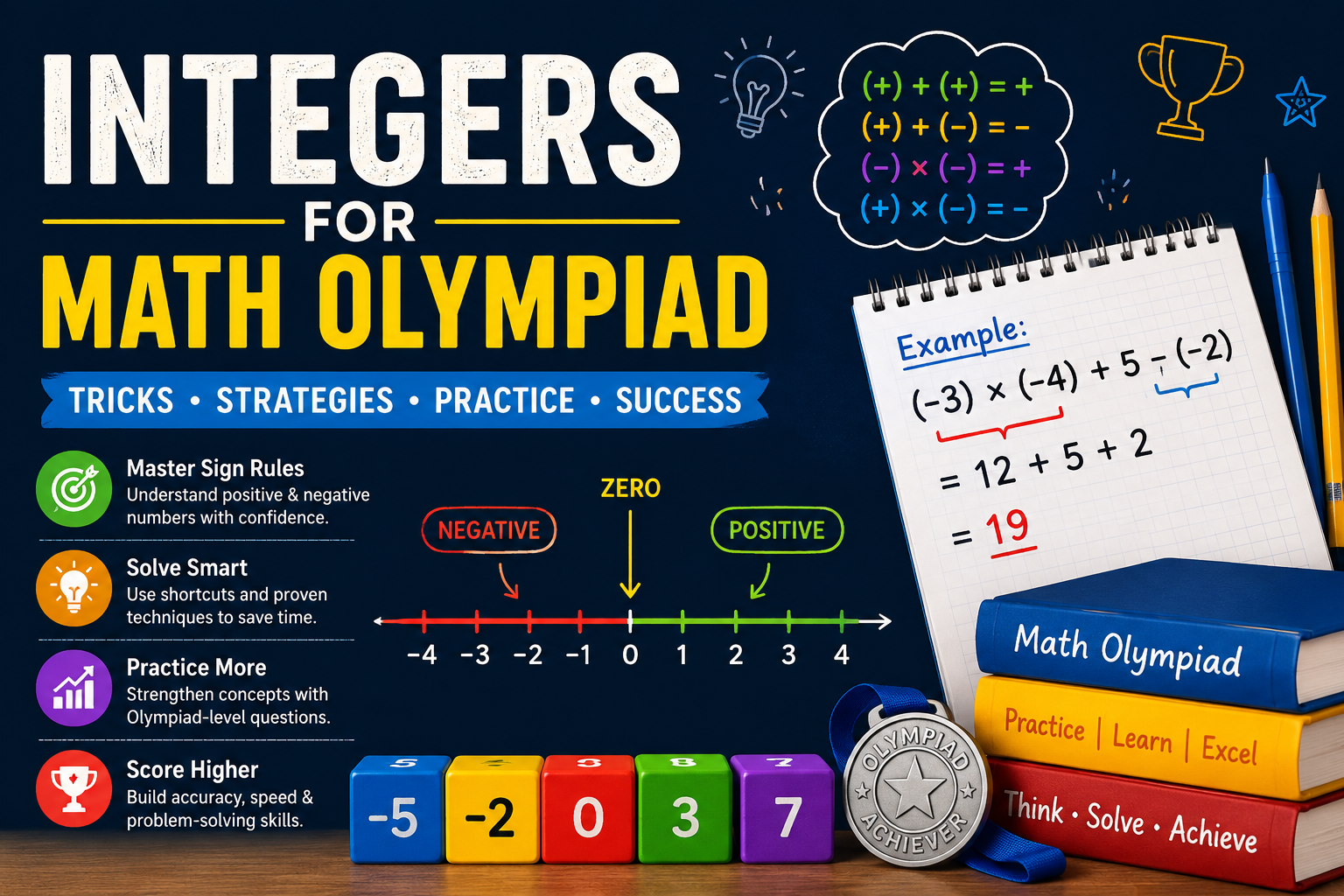
Sign rules should become automatic before attempting difficult Olympiad questions. For multiplication and division, remember:
- Positive × positive = positive
- Positive × negative = negative
- Negative × positive = negative
- Negative × negative = positive
The same sign principle applies to division. When working through integers for Math Olympiad questions, count the negative factors carefully. An even number of negative factors produces a positive result, while an odd number produces a negative result.
Step 2: Use the Number Line
The number line is one of the easiest ways to visualize integers. Positive numbers lie to the right of zero, while negative numbers lie to the left. Moving toward the right means increasing the value, and moving toward the left means decreasing the value.
This visual method is especially helpful when learning integers for Math Olympiad because it makes comparison, addition, subtraction, and absolute value easier to understand. For example, -5 is smaller than -3 because -5 lies farther to the left on the number line.
Step 3: Practice BODMAS with Integers
Olympiad questions frequently combine several operations. Students should therefore practice BODMAS or the correct order of operations with integer expressions. Always solve brackets first, followed by orders, division and multiplication, and then addition and subtraction.
When preparing integers for Math Olympiad, do not rush through a long expression. Write each step clearly. This reduces sign errors and makes it easier to identify where a mistake occurred.
Step 4: Solve Integer Word Problems
Integer word problems connect mathematics with real-life situations. Temperature changes, bank balances, elevation, game scores, profit and loss, and movement can all be represented using integers.
For effective integers for Math Olympiad preparation, students should practice converting words into mathematical expressions. Words such as “increase,” “rise,” and “gain” often indicate positive changes, while “decrease,” “fall,” and “loss” may indicate negative changes.
Common Mistakes to Avoid
Many students understand integers but lose marks because of avoidable errors. These mistakes become more common when a question contains multiple steps. The following areas deserve special attention during integers for Math Olympiad practice.
- Sign errors: Always count and track negative signs when multiplying or dividing several integers.
- Confusing subtraction: Remember that subtracting a negative number changes the operation. For example, 5 – (-3) = 5 + 3 = 8.
- Incorrect ordering: More negative integers are smaller. Therefore, -5 < -3.
- Absolute value confusion: Absolute value represents distance from zero and is never negative.
- Ignoring brackets: Brackets can completely change the result of an integer expression.
- Rushing calculations: Speed matters in Olympiads, but accuracy should come first.
Practice Questions for Integer Olympiad Preparation
The best way to strengthen integers for Math Olympiad skills is to solve different types of questions. Try these competition-style examples.
Question 1: Sign Chain
Find:
(-3) × (-4) × (-2) × 5
Solution: There are three negative numbers. Since three is odd, the final answer is negative. Calculate the absolute values:
3 × 4 × 2 × 5 = 120
Therefore, the answer is -120.
Question 2: Temperature Problem
The temperature at midnight was -7°C. By noon, it increased by 15°C and then dropped by 9°C in the evening. What was the evening temperature?
Solution:
-7 + 15 – 9 = 8 – 9 = -1°C
This type of question is useful for integers for Math Olympiad because it requires students to translate changes in temperature into integer operations.
Question 3: Integer Pattern
What is the sum of all integers from -50 to 50?
Solution: Pair every negative integer with its positive counterpart:
(-50 + 50) + (-49 + 49) + … + (-1 + 1) + 0 = 0
Therefore, the answer is 0. Recognizing these pairs is a useful Olympiad technique and an important part of integers for Math Olympiad problem solving.
How Olympiad Questions Test Integer Skills
School-level questions often test whether students know the basic rules of integers. Olympiad questions usually go one step further. They may combine several concepts, hide the required operation inside a word problem, or introduce a pattern that needs to be recognized.
Strong integers for Math Olympiad preparation should therefore include different levels of difficulty. Begin with straightforward operations, then move to expressions with brackets, word problems, patterns, and timed practice.
Students should also develop the habit of checking answers. Ask whether the sign is reasonable, whether the size of the answer makes sense, and whether the operation was performed in the correct order. These small habits can significantly improve performance in competition exams.
How to Improve Speed and Accuracy
Speed improves naturally when students practice the same concepts in different forms. Instead of repeatedly solving identical questions, use mixed practice. Include multiplication and division, comparison, absolute value, number-line questions, expressions, and word problems.
For integers for Math Olympiad, a useful routine is to solve 10–15 questions regularly and review every incorrect answer. Maintain a mistake notebook and write down the reason for each error. Was it a sign mistake? Did you ignore a bracket? Did you misread the question? Identifying the reason prevents the same mistake from happening again.
Practice Integers with SparkEd
SparkEd provides structured practice for students preparing for Olympiad mathematics. Students can work through curated integer questions, use step-by-step guidance, and gradually increase the difficulty of their practice.
For students studying integers for Math Olympiad, regular practice can make challenging questions feel much more manageable. The focus should be on understanding the reasoning behind each solution rather than simply memorizing answers.
Ready to Master Integers?
Strengthen your integer concepts with visual explanations, guided practice, and Olympiad-level questions. Build confidence step by step and improve both accuracy and speed.
Frequently Asked Questions
How important are integers for SOF IMO?
Integers are an important area of Olympiad mathematics. Questions can test integer operations, negative numbers, ordering, patterns, and real-world applications.
What is the best way to practice integers?
Practice regularly and include a mixture of calculations, word problems, patterns, and multi-step expressions. Reviewing mistakes is just as important as solving new questions.
How are Olympiad integer questions different from school questions?
Olympiad problems generally require more reasoning. They may combine several operations, include tricky wording, use patterns, or require students to identify an efficient method rather than simply apply a rule.
Can Class 6 and Class 7 students practice integers for Olympiads?
Yes. Students in Classes 6 and 7 can build a strong foundation by mastering integer operations first and then progressing toward more challenging Olympiad-style questions.
Final Takeaway
Integers are much more than a basic arithmetic chapter. They develop the sign awareness, logical thinking, calculation accuracy, and pattern recognition required for competitive mathematics. A focused approach to integers for Math Olympiad can help students become comfortable with positive and negative numbers, complex expressions, word problems, and challenging patterns.
Start with the fundamentals, practice sign rules, use the number line, solve multi-step expressions, and regularly attempt competition-style problems. With consistent integers for Math Olympiad practice, students can turn one of the most error-prone topics into a reliable scoring opportunity.